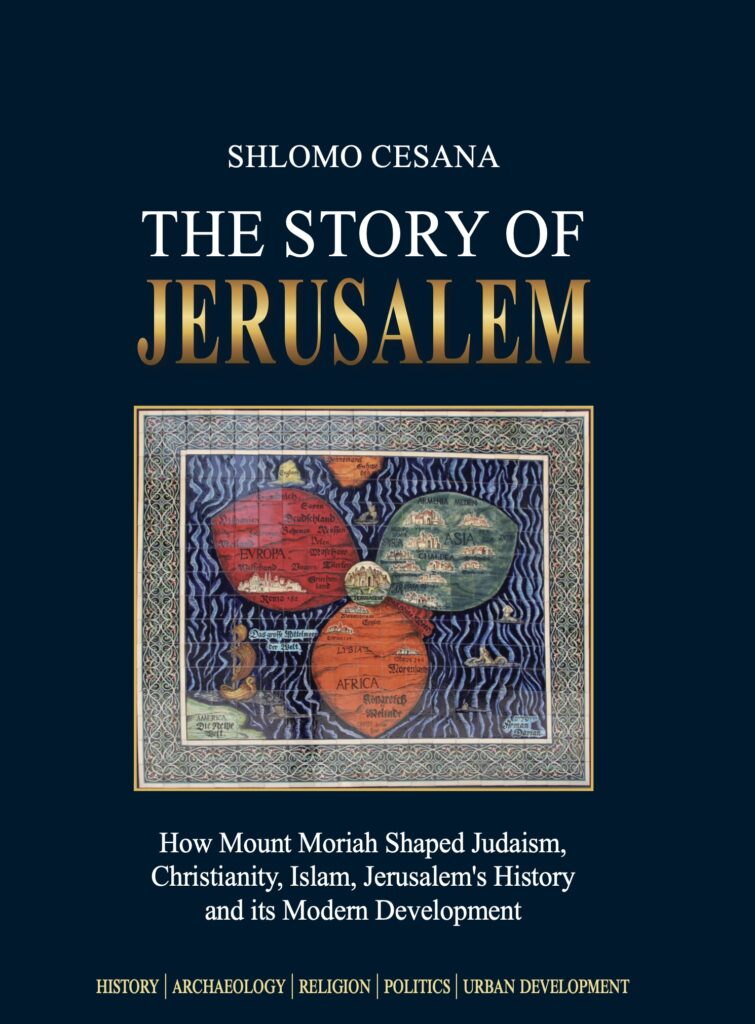
How Mount-Moriah Shaped Judaism, Christianity, Islam, Jerusalem's History and its Modern Development
BY SHLOMO CESANA
?Why Jerusalem Still Matters After 4,000 Years
Few cities have been studied, fought over, prayed for, and written about as much as Jerusalem. Yet for all that attention, the city remains remarkably difficult to understand. History, religion, archaeology, politics, and national identity overlap here so completely that separating one from another can obscure more than it explains.
The Story of Jerusalem takes a different approach. Rather than offering another chronological history of the city, the book asks a more fundamental question: Why did Jerusalem become so important in the first place, and why has its hold on the human imagination endured for thousands of years?
At the heart of the book is one powerful idea: the ancient belief that Jerusalem is the place where heaven and earth meet, where God chose to dwell, and where prayers are received.
The Temple on Mount Moriah gave that belief a physical center. But the idea did not disappear when the Temple was destroyed. It survived, evolved, and became intertwined with Christianity and Islam, helping transform Jerusalem from the sacred center of an ancient people into a city revered across much of the world.
From this starting point, the book moves across 4,000 years of history, examining archaeological discoveries, changing rulers and populations, urban development, holy sites, political struggles, and Jerusalem’s modern role as Israel’s capital.
What distinguishes the book is the unusual perspective of its author, Shlomo Cesana, an Israeli journalist, archaeologist, author, and longtime Jerusalem tour guide. Those different disciplines allow him to approach the city not simply as a collection of historical events, but as a living place in which ancient beliefs continue to shape streets, borders, politics, and human behavior.
The result is also an attempt to make sense of Jerusalem’s competing narratives. Judaism, Christianity, Islam, archaeology, nationalism, and modern politics are not treated as separate subjects. Instead, the book examines the points at which they intersect, reinforce one another, and collide.
That makes The Story of Jerusalem particularly relevant to readers trying to understand why events in this relatively small city can still reverberate around the world.
For anyone interested in Jerusalem, the Holy Land, archaeology, religion, or the roots of the modern Middle East conflict, the book offers something increasingly valuable: context.
The Story of Jerusalem is available on Amazon
Why Jerusalem?What makes one city a center of faith, conflict, and longing for thousands of years? How did a small hilltop settlement become a global city? And why has Jerusalem drawn empires and rulers, prophets and preachers, believers and tourists across generations
A Unique Approach
In The Story of Jerusalem, Shlomo Cesana explores the city’s exceptional status through his three areas of expertise: journalism, archaeology, and guiding. Together, these perspectives help explain how Jerusalem became one of the most influential and contested cities in history
The Central Idea
This analysis points to one powerful idea that has shaped Jerusalem across time: the enduring belief, shared by so many, that Jerusalem is the city of God. The book connects the city’s history, its urban development, and its renewal as the capital of the State of Israel to this belief. It gives readers deeper insight into why Jerusalem stands apart from every other city
Available now to read on Amazon Click here